
At Lync Wealth, our role is to help you cut through the noise and focus on what matters most for your long-term financial picture.
Although the current events will be naturally driving short-term volatility, bear in mind markets will always fall and rise in the short term based on world events.
Our portfolio’s at Lync Wealth focus on long-term investing in mind, not the short term.
How your portfolios are positioned
Your portfolios remain intentionally diversified across regions and asset classes, helping to cushion the effect of sudden geopolitical events.
We maintain near-zero direct exposure to Iran or Israel within our equity and emerging‑market bond holdings. For context, the MSCI World Index also has only a very small allocation to Israel – around 0.06%, even within higher‑risk strategies – which reduces the potential for direct market impact.
How we’re responding to new information
There’s no need to adjust positioning at this stage, but we’re monitoring the situation closely.
Each day, we review market data, research insights and how our models interpret new developments. These tools support our decision making, though they don’t remove uncertainty or predict outcomes. If conditions change in a way that matters for your plan, we’ll be ready to act.
How the markets responded
When markets opened on Monday (2 March), the initial response was measured:
- FTSE 100 was down 2.8%
- US futures also slightly lower
- Asian markets slightly weaker
- Oil prices up around 15%
Given the Middle East’s importance to global shipping and energy routes – including the Strait of Hormuz, Iran – it’s not unusual for oil markets to respond quickly during periods of tension. Even so, prices remain within the range of recent years.

Source: FactSet
Why energy matters for investors
If energy prices remain high, they can put upward pressure on inflation. This may influence both interest‑rate expectations and how government bonds behave in the short term. This is one of the reasons we use a broad blend of assets, not just bonds, to help manage risk across different environments.
Looking at today’s events in a broader context
Market reactions during geopolitical events can feel unsettling. But history shows that many past conflicts have not led to prolonged market declines, and global markets have often stabilised within months.
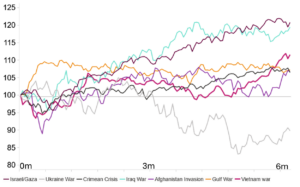
Source: FactSet. Performance of the MSCI AC World in USD.
Every situation, of course, is different – and past performance isn’t a guide to the future – but stepping back helps us keep short‑term movements in perspective.
If you’d like to talk things through
Periods like this can bring questions about your long‑term plans. If you’d like to understand more about what we’re watching, or simply want reassurance, please reach out to your Lync adviser. We’re here to help.
This communication is for general information only and does not constitute advice. Past performance is not a guide to future results.